Leave Your Message
Choosing among China’s top Glamping Tent manufacturers requires more than comparing factory prices. A reliable supplier must combine weather-resistant fabrics, stable frame systems, skilled workmanship, and consistent quality control. The best manufacturers also understand how guests move through a tent, where condensation gathers, and how canvas behaves after repeated rain. These details matter in real projects.
Ruben Martinez, founder of the American Glamping Association, has said, “Glamping is a way to experience the outdoors without sacrificing comfort.” That idea helps define this industry. A successful Glamping Tent should feel close to nature, yet remain practical for sleeping, bathing, heating, and daily maintenance. A beautiful sample is not enough. Buyers should inspect stitching, zippers, floor membranes, insulation, fire-safety documentation, and replacement-part availability.
China has developed strong manufacturing capabilities in this field. Many suppliers offer customized sizes, private-label production, and complete interior packages. However, not every attractive catalog reflects dependable field performance. Some factories communicate well before payment, then respond slowly during installation. That risk deserves attention. Factory audits, material samples, video inspections, and independent testing can reduce unpleasant surprises.
This guide examines manufacturers through experience, technical knowledge, production capacity, and after-sales reliability. It considers their tent structures, fabric options, customization services, delivery records, and suitability for different climates. The ranking cannot be perfect, because project conditions vary widely. A coastal resort, mountain camp, and desert site need different solutions. Careful comparison remains essential.
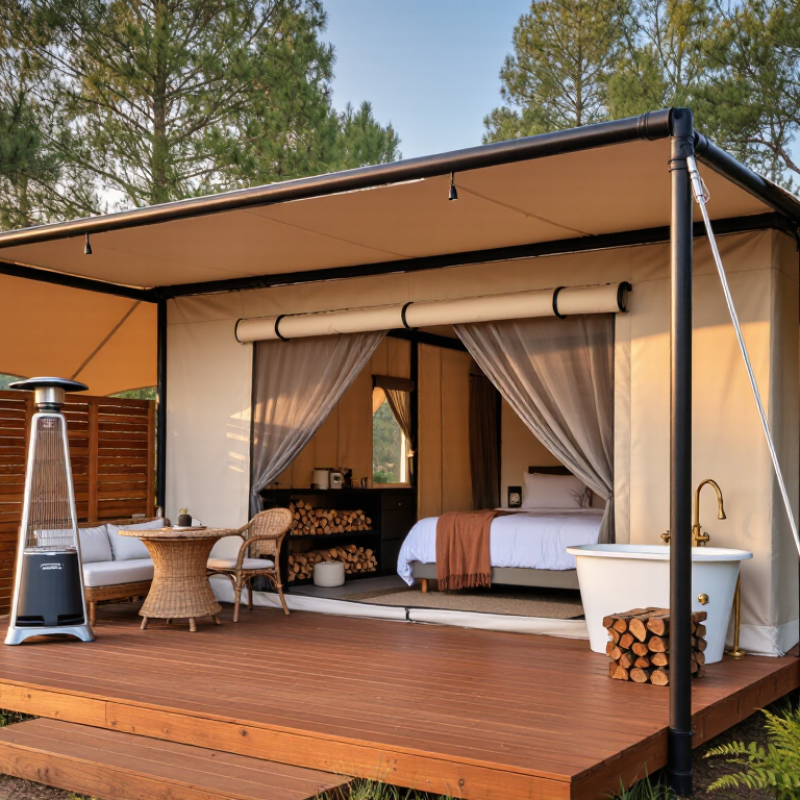
A top glamping tent manufacturer in China is defined by controlled quality, not attractive photographs. Grand View Research estimates that the global glamping market will continue expanding strongly through 2030, increasing pressure on suppliers to deliver safer, longer-lasting structures. Experienced manufacturers should show production records, material certificates, and documented quality checks for every major component.
Material selection reveals practical expertise. A reliable factory can explain fabric weight, waterproof ratings, UV resistance, flame-retardant treatment, and cold-weather performance in clear terms. Seams should be reinforced where rainwater collects. Zippers must operate smoothly after repeated use. Steel or aluminum frames need consistent dimensions, corrosion protection, and load testing. Small details matter.
Independent testing helps, but it is not everything. ISO-based quality systems, factory audits, and third-party inspection reports can improve confidence, while local building and fire requirements still require project-specific review. The UNWTO and Global Wellness Institute have both reported sustained growth in nature-based and wellness tourism, creating demand for comfortable accommodation outside traditional hotels. Yet rapid demand can expose weak production controls. Some suppliers publish impressive specifications but provide limited aging data. That deserves questions. Buyers should request sample units, installation videos, replacement-part policies, and references from comparable climates. A top manufacturer communicates limitations honestly. No supplier gets every decision right. The best ones measure mistakes, revise designs, and keep evidence.
A practical evaluation framework based on product engineering, manufacturing capability, quality control, compliance, and after-sales support
| Evaluation Dimension | Practical Benchmark for a Top Manufacturer | Relevant Data or Technical Indicator | How Buyers Can Verify It | Why It Matters |
|---|---|---|---|---|
| Product Range | A broad portfolio covering safari tents, dome tents, cabin tents, bell tents, and customized resort structures. | Multiple structural formats Seasonal options Custom layouts | Review a current catalog, technical drawings, completed-project photographs, and available floor plans. | A wider range helps operators match the tent structure to climate, land conditions, guest capacity, and project positioning. |
| Fabric Construction | Commercial-grade coated polyester or PVC-coated fabric selected according to the intended climate and service life. | Typical commercial fabric weights are approximately 500–900 g/m², depending on the product design and coating system. | Request fabric composition, weight, coating details, color-fastness information, and independent laboratory reports where available. | Fabric specification affects waterproofing, tear resistance, UV performance, cleanability, weight, and replacement cost. |
| Waterproofing Performance | The roof, seams, doors, windows, and connection points should be designed as one integrated weatherproof system. | Hydrostatic-pressure results are commonly stated in millimeters; commercial tent fabrics may be specified around 3,000–10,000 mm, depending on material and application. | Check hydrostatic-pressure test reports, seam-sealing procedures, drainage details, and water-spray test records. | Water resistance is essential for guest comfort, interior durability, and reducing mold or moisture-related maintenance. |
| Wind-Resistance Design | The manufacturer provides project-specific wind guidance rather than relying only on a general marketing claim. | Many leisure-tent specifications reference design targets in the approximate range of 80–120 km/h; the actual rating depends on anchoring, structure, site exposure, and installation. | Request structural calculations, anchoring plans, installation instructions, and documented wind-test or engineering data. | Wind performance depends on the complete installed system, not fabric strength alone. Site conditions must be assessed before purchase. |
| Frame and Hardware | Frames use appropriately specified galvanized steel, aluminum, or engineered timber with corrosion-resistant connectors. | Key checks include tube or beam dimensions, steel coating, aluminum alloy, fastener material, connector design, and load-bearing details. | Ask for material certificates, component drawings, corrosion-protection details, and photographs of concealed joints. | Frame quality influences structural stability, assembly accuracy, service life, and the ability to withstand repeated installation. |
| Fire Safety | Materials and finished assemblies are selected according to the destination market and the site’s fire-safety requirements. | Fire classifications differ by jurisdiction. European projects may reference standards such as EN 13501-1, while other markets may require different test methods. | Request valid test reports that identify the exact fabric, coating, construction, and standard used for testing. | Fire performance can affect permits, insurance, guest safety, and acceptance by local authorities. |
| Manufacturing Capacity | The factory can manage cutting, welding or sewing, frame fabrication, finishing, packing, and final inspection in a coordinated process. | Useful indicators include production-line capacity, lead time by order size, monthly output, equipment list, and peak-season planning. | Request a factory audit, production schedule sample, equipment photographs, and evidence of recent comparable orders. | Stable capacity reduces delays, inconsistent batches, and installation problems during large resort projects. |
| Quality-Control System | Quality control covers incoming materials, in-process production, finished products, packing, and shipment release. | A mature process normally includes documented inspection points, dimensional checks, seam checks, hardware checks, and pre-shipment inspection. | Ask for inspection checklists, nonconformity procedures, sample quality reports, and product traceability records. | Documented quality control is more reliable than visual inspection alone and helps prevent repeated defects across multiple units. |
| Customization Capability | The manufacturer can adapt dimensions, entrances, windows, insulation, bathrooms, decks, internal partitions, and utility openings. | Custom engineering should define tolerances, allowable modifications, weight changes, drainage routes, and installation implications. | Review approved drawings, revision-control procedures, prototype samples, and examples of modified configurations. | Well-managed customization allows the tent to fit local planning rules, guest requirements, furniture layouts, and terrain limitations. |
| Insulation and Climate Adaptation | The design is adapted to hot, cold, humid, coastal, rainy, or high-altitude environments instead of using one universal configuration. | Options may include insulated liners, reflective layers, ventilation openings, insect screens, double roofs, condensation control, and heating or cooling provisions. | Request climate-specific specifications, material layers, ventilation diagrams, and operating recommendations. | Climate adaptation improves indoor comfort, energy efficiency, condensation control, and the usable season of the accommodation. |
| Installation Support | The supplier provides clear installation documentation and can support local installers or project teams when required. | Recommended documents include a packing list, foundation or platform requirements, assembly drawings, anchoring details, maintenance instructions, and replacement-part references. | Request a complete installation manual, training plan, site-support terms, and photographs of completed installations. | Correct installation is critical to waterproofing, structural performance, appearance, and warranty validity. |
| Packaging and Logistics | Components are labeled, moisture-protected, grouped by installation sequence, and packed for efficient international transport. | Important logistics data includes package dimensions, gross weight, container loading plan, spare-parts quantity, and shipping documentation. | Request a sample packing list, container-loading plan, package photographs, and shipping marks before production approval. | Good packing reduces transit damage, missing components, customs delays, and installation downtime. |
| Warranty and Spare Parts | Warranty terms clearly distinguish fabric, frame, hardware, windows, doors, electrical items, and consumable components. | A credible warranty should state coverage period, exclusions, claim procedure, maintenance obligations, and replacement-part availability. | Review the written warranty, spare-parts list, repair process, and expected response time for technical claims. | Clear after-sales terms protect the operator’s investment and reduce long-term maintenance uncertainty. |
| Compliance Documentation | The supplier can provide documents relevant to the importing country, product category, and project approval process. | Depending on the project, documentation may include material test reports, fire reports, structural information, packing records, and declarations required by local authorities. | Confirm that reports identify the actual product materials and are current, traceable, and issued by a competent testing organization. | Complete documentation supports customs clearance, permitting, insurance review, and professional project approval. |
| Project Experience | The manufacturer can demonstrate experience with comparable climate, occupancy, scale, and installation conditions. | Relevant project data includes unit quantity, tent type, climate zone, installation year, operating status, and maintenance history. | Request anonymized case studies, project references, technical photographs, and evidence that installations have been operating successfully. | Comparable project experience helps identify practical risks that may not appear in a catalog or quotation. |
| Total Cost of Ownership | The quotation considers the complete delivered and installed solution rather than only the ex-factory tent price. | Cost categories may include tent, frame, platform, insulation, furniture, utilities, transport, duties, installation, maintenance, and replacement materials. | Compare itemized quotations with identical specifications, delivery terms, warranty coverage, and installation responsibilities. | A lower initial price may result in higher lifetime costs if materials, maintenance, installation, or spare parts are excluded. |
Important: The numerical ranges shown above are indicative commercial benchmarks, not universal certification limits or guarantees. Final requirements should be confirmed through project-specific engineering, local building and fire regulations, independent testing, site conditions, and the manufacturer’s written technical documentation.